While looking into something else, I stumbled upon the slides from Bruce Perens' presentation, AMBE Exposed This is from a TAPR/DCC talk in the fall of 2014. I'm not sure how I missed it at the time.
There is also a video of the talk which I haven't watched yet, on YouTube.
If you are interested in the problem of the patent encumbered CODECs that are used in DMR/MotoTRBO, APCO P25, D-STAR, and Yaesu System Fusion that keep developers from delivering the capabilities we'd like in our radio software/firmware, give this a read.
The presentation is 57 slides and chock full of background information.I'm going to keep this filed for when questions come up about why we can't do this or that without buying a dongle or using some limited software from anonymous authors.
This comes up over and over. Why doesn't my SDR, scanner, radio do DMR/MotoTRBO, D-Star, P25, etc. Recently this has come up again now that Uniden announced a DMR upgrade (for a fee) to their newest scanners the BCD-436HP and BCD-536HP. These radios already do P25 Phase 1 and 2, but there is a fee for the DMR upgrade to cover both the development costs and of course additional licensing fees to DVSI.
This will probably be of most interest to those that are familiar with and interested in open source.
There are also some good points about innovation usually coming from the upstarts and not the old guard.
Showing posts with label Open Source. Show all posts
Showing posts with label Open Source. Show all posts
Monday, May 23, 2016


Saturday, March 29, 2014
Cool Technology: IPython Notebooks
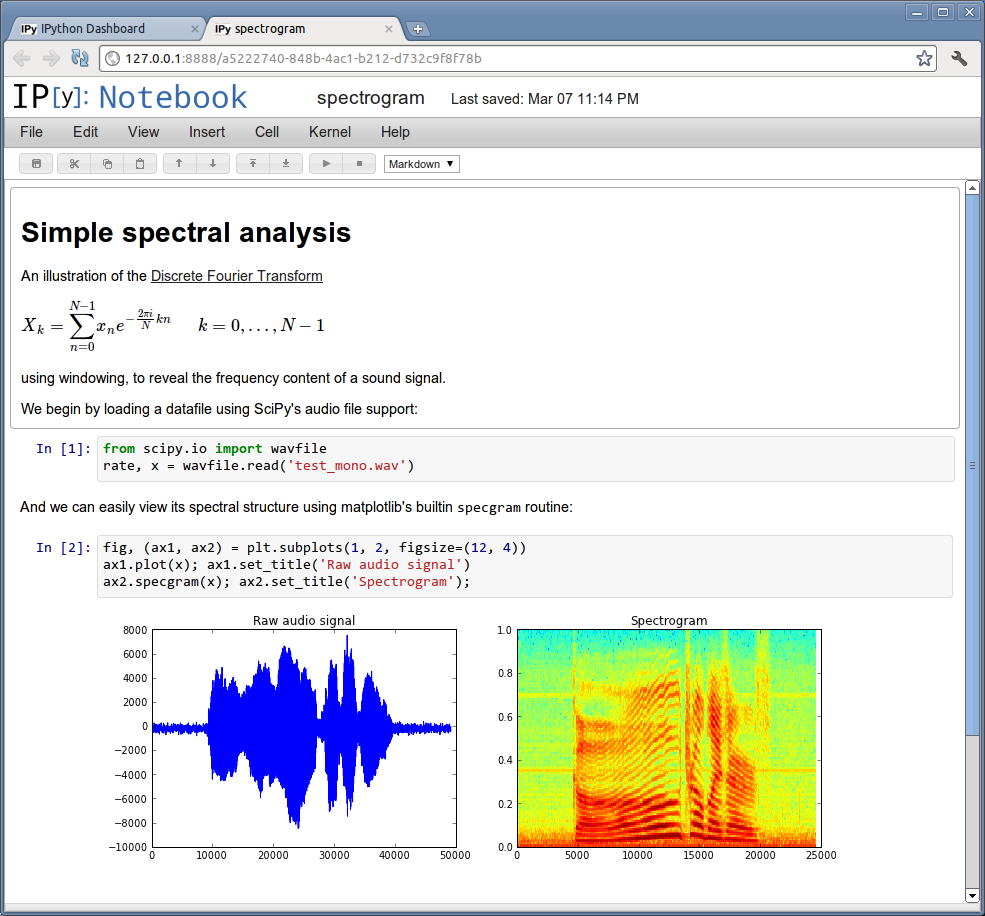
I may be very late to the party but I've recently discovered IPython notebooks. IPython is an extremely useful Python shell environment that has been kicking around for 10+ years. Initially the number of advantages it offered over the built-in python shell was small. But then again it started out as a couple of hundred line hack. So back then it seemed like it wasn't worth the trouble to make sure it was install on all the machines you might hack Python on.
Fast forward to 2010 or so, IPython has reached a 1.0 milestone, and has evolved significantly to an extremely powerful platform. However the aspect that I find the most useful is notebooks that display in a web browser. It's supposed to be somewhat reminiscent of Mathematica which I've never used.
Notebooks contain blocks of executable Python code and their output. The Python code can be edited and run/rerun right there from the browser. But where it really gets interesting is that rich multimedia stuff, especially graphs can be displayed right there, in-line. It's pretty enabling for scientific computing, enabling very short hacking and visualization cycles almost like a spreadsheet.
I really should write a lot more about this. It's not just for Python, and it's not just for the web, it seems like it could be a big thing. It should also make teaching and learning a lot easier.
Check out:

There are a few things that I think could use improvement.
Fast forward to 2010 or so, IPython has reached a 1.0 milestone, and has evolved significantly to an extremely powerful platform. However the aspect that I find the most useful is notebooks that display in a web browser. It's supposed to be somewhat reminiscent of Mathematica which I've never used.
Notebooks contain blocks of executable Python code and their output. The Python code can be edited and run/rerun right there from the browser. But where it really gets interesting is that rich multimedia stuff, especially graphs can be displayed right there, in-line. It's pretty enabling for scientific computing, enabling very short hacking and visualization cycles almost like a spreadsheet.
I really should write a lot more about this. It's not just for Python, and it's not just for the web, it seems like it could be a big thing. It should also make teaching and learning a lot easier.
Check out:
- The IPython Notebook
- How to run code in the IPython Notebook,
- Basic Output
- Rich display system
- matplotlib tutorial
There are a few things that I think could use improvement.
- More Document Structure, Real Head 1, 2, 3 and Table of Contents. I'm a big fan of Mediawiki's nice native built-in structure. It really helps organize documents in my opinion. It's also one of the biggest things lacking from Evernote (IMHO).
- Native Tabular output widgets. There are some extensions but they aren't quite there yet. This could make an awesome SQL Workbench, but it could really use ways of presenting and working with tables as output cells.
Tuesday, April 24, 2012
APRSDroid, freely available APRS app for Android phones
Here's another post that I've sent to a mailing list, that I thought might be worth sharing more widely. Many more people have Android phones with a built in GPS than have APRS capabilities via their radios. This could be a useful tool in the toolbox for those who do public service events.
The APRSdroid application provides APRS functionality for Android Phones. An installable .apk as well as the source code are freely available from the developer's site.
The app enables sending and receiving APRS beacons and messages via a data (internet) connection to the APRS-IS network. Map data is also downloaded from the internet. (This mode requires that you have cellular data coverage.)
The app can also generate AFSK tones for sending ARPS beacons and messages via a connection from your phone's earphone jack to your HT's microphone. Note VOX capability is needed. The ability to decode AFSK tones isn't implemented yet, so it's not a complete software TNC replacement. However, it's on the requested feature list.
I was successful in making a straight-through connection from my Samsung Galaxy Nexus to my Wouxun KG-UV2D. My Yaesu VX-8DR had no problems decoding the packets from APRSdroid via the Wouxun. I need to go out to some open spaces to test how well it will be picked up by actual APRS digitpeaters. It can be pretty hard to get APRS beacons out on NYC streets. In general 2 meters can be pretty spotty on the streets in NYC. 70cm does a much better job of being reflected off of buildings, which is expected.
An alternate version of the application that uses pre-downloaded offline maps is available. This can be handy in places where there is no cellular coverage. I was able to get APRSdroid loaded and running on the Kindle Fire using the offline maps version (OSM). The Kindle Fire is really too limited of a device to be useful for APRS since it doesn't have GPS or cellular data service. However, it does have a 7" screen which would be useful for
iPhone users: I've seen similar apps listed in the app store, but I have no experience with them.
The APRSdroid application provides APRS functionality for Android Phones. An installable .apk as well as the source code are freely available from the developer's site.
- http://aprsdroid.org/
The app enables sending and receiving APRS beacons and messages via a data (internet) connection to the APRS-IS network. Map data is also downloaded from the internet. (This mode requires that you have cellular data coverage.)
The app can also generate AFSK tones for sending ARPS beacons and messages via a connection from your phone's earphone jack to your HT's microphone. Note VOX capability is needed. The ability to decode AFSK tones isn't implemented yet, so it's not a complete software TNC replacement. However, it's on the requested feature list.
I was successful in making a straight-through connection from my Samsung Galaxy Nexus to my Wouxun KG-UV2D. My Yaesu VX-8DR had no problems decoding the packets from APRSdroid via the Wouxun. I need to go out to some open spaces to test how well it will be picked up by actual APRS digitpeaters. It can be pretty hard to get APRS beacons out on NYC streets. In general 2 meters can be pretty spotty on the streets in NYC. 70cm does a much better job of being reflected off of buildings, which is expected.
An alternate version of the application that uses pre-downloaded offline maps is available. This can be handy in places where there is no cellular coverage. I was able to get APRSdroid loaded and running on the Kindle Fire using the offline maps version (OSM). The Kindle Fire is really too limited of a device to be useful for APRS since it doesn't have GPS or cellular data service. However, it does have a 7" screen which would be useful for
iPhone users: I've seen similar apps listed in the app store, but I have no experience with them.
Subscribe to:
Posts (Atom)